What I Found When I Checked: A Mother's Story
The System That Was Built to Be Missed..
A parent told me something recently that I haven’t been able to shake.
She grew up in the Bluetooth era. Porn passed phone to phone in school corridors, shared in groups, treated as currency and joke and rite of passage all at once. Nobody called it what it was. It was just what happened. You didn’t ask where it came from, you just watched, and then you passed it on.
She never thought it would touch her own children the same way. That generation felt different, safer somehow, or maybe she just hadn’t let herself think about it too closely.
And then, on instinct, she checked her twelve year old’s phone.
She described it to me as one of the worst moments of her life. Not because of what a stranger had done to her child, but because of what her child had access to, shared, and was part of, without her having any idea. Groups built entirely around swapping pornographic content. Other children, the same age, doing the same thing back and forth like it was nothing.
Her first feeling wasn’t anger at her son. It was horror at herself. How did this happen under my own roof, she asked me. I thought I’d have noticed something. I thought there’d be a sign.
Here’s the uncomfortable truth underneath that moment. We keep talking about children as though they’re only victims of this ecosystem. Many are. But some are also participants, not because they’re predators, but because this has become normal. Children aren’t just being exposed to the system anymore. They’re helping sustain it, often without understanding what they’re taking part in.
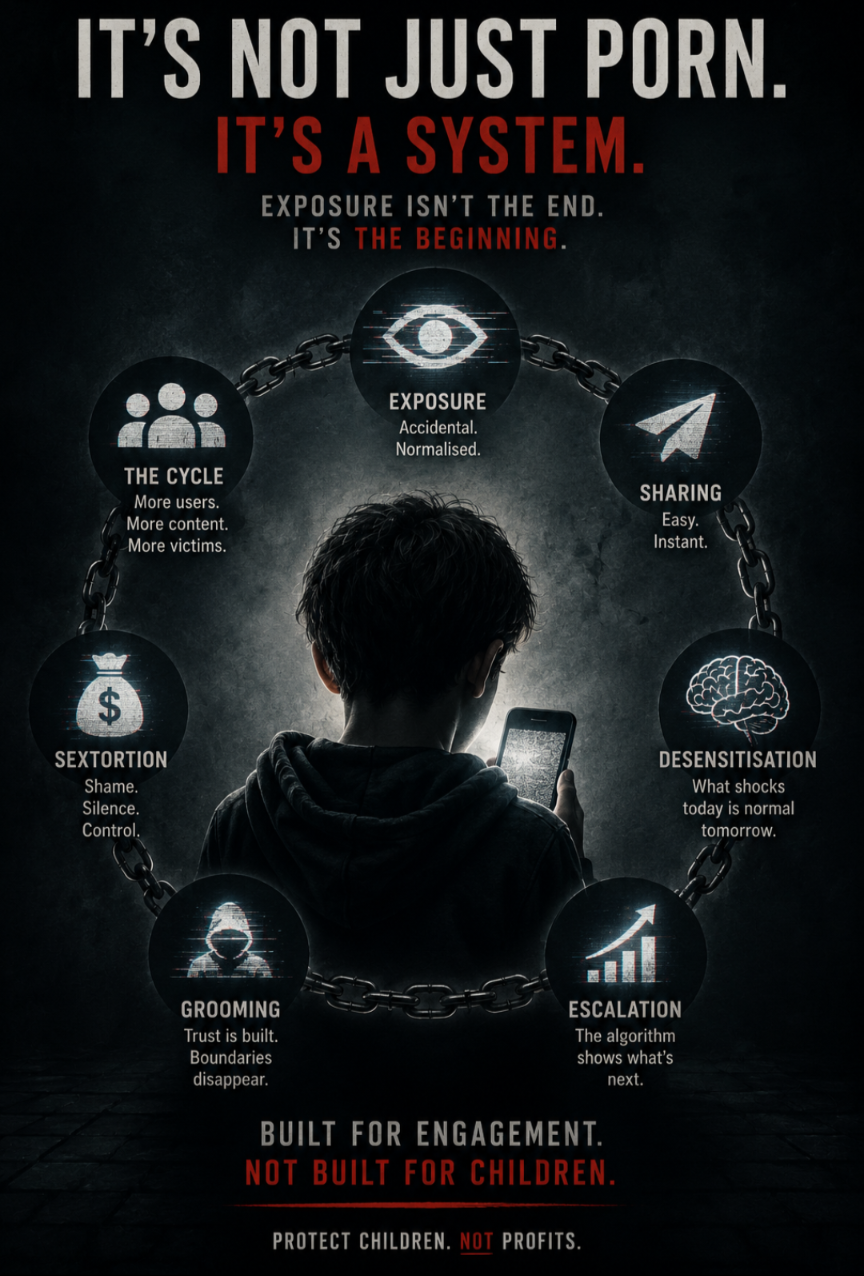
That’s not a story about pornography. Pornography is just where you enter it. The actual story is a chain: exposure, sharing, desensitisation, escalation, grooming, sextortion. Each stage makes the next one easier, and each one has been quietly built into the platforms children use every day, not by accident but by design choices nobody made with a twelve year old in mind.
Safeguarding often imagines harm as something that begins with an offender. Increasingly, harm begins with an environment.
Discord comes up constantly in conversations I have with people who research or have lived through this. Predators I’ve spoken to in the course of my work have described it, unprompted, as a network they use. Not a loophole they exploit occasionally. A network. Structured servers, tiered access, communities built specifically around sharing content between minors, sometimes with barely any adult presence required to keep it running once it exists. Parents hear “Discord” and think gaming chat. It is very often something else entirely.
But Discord is just one visible piece of something bigger. The system that was built to be missed isn’t any single app. It’s the algorithms that reward engagement over safety. The frictionless sharing that turns one image into hundreds within hours. The recommendation systems that quietly escalate what a child sees next. The endless scroll that removes every natural pause a parent might have relied on. The private group chats that exist entirely outside adult visibility by design, not oversight failure. These systems were built to maximise engagement, not child safety. When engagement becomes the overriding objective, children inevitably become collateral damage.
What strikes me most about what this parent described isn’t the shock of discovery. It’s the gap between how much a parent can care and how little that guarantees. She wasn’t careless. She wasn’t absent. She checked her son’s phone because something felt off, and she was still horrified by what she found. The danger wasn’t external. It was ambient. It was the water her child was swimming in, same as it was the water she swam in at that age, just engineered this time, at scale, for profit.
The greatest safeguarding failure of the next decade won’t be that we didn’t know. It’ll be that we kept treating the environment as neutral when it wasn’t.
The question is no longer whether children will encounter pornography online. Most already have. The question is whether we’re prepared to admit that the environment surrounding them has fundamentally changed, while our safeguarding has not.
We’re still teaching children how to use the internet. We should be asking what kind of internet we’ve built for children to use.