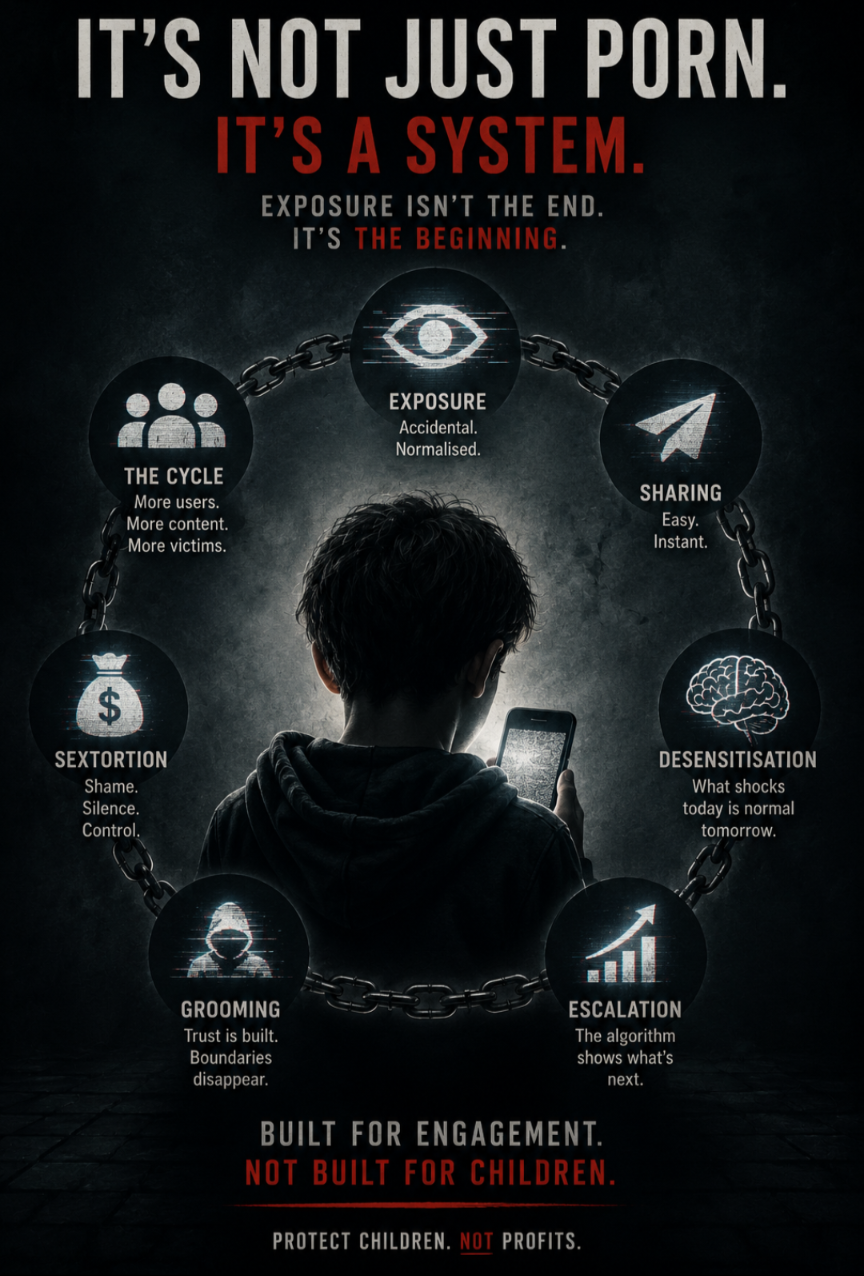
The Pornography Epidemic: How Exposure, Escalation and Extortion Are Converging on a Generation of Children

Something has shifted in the last decade, and most adults have not caught up with it. Pornography is no longer something a teenager stumbles across on a borrowed magazine or a late night television channel. It is delivered, unsolicited, into group chats, Snapchat streams and social media feeds, often before a child has had a single conversation about what sex or consent actually mean. What follows is not a single crisis but three connected ones: normalisation, escalation, and extortion. Each feeds the next.
The Normalisation
The Children’s Commissioner’s 2025 survey of young people in England found that 70% of respondents had seen pornography before the age of 18, up from 64% in 2023. More than a quarter had seen it by the age of 11, and some children reported first exposure at six years old or younger.
Crucially, this is not framed by most children as something they went looking for. Fifty nine per cent said they encountered pornography by accident, a sharp rise from 38% in 2023, and social media platforms, rather than dedicated adult sites, are now a primary route of exposure. This is happening on the same apps children use to message friends and do their homework.
The content itself is also more extreme than most parents assume. Seventy nine per cent of respondents had encountered violent pornography, depicting coercive, degrading or pain inducing acts, before turning 18. This is not incidental. The Commissioner’s report found that frequent users of pornography were more likely to engage in physically aggressive sex acts themselves, and that early exposure was measurably shaping attitudes. Among children who had seen pornography online, 54% of girls and 41% of boys agreed that girls may say no at first but then can be persuaded, compared with 46% and 30% respectively among those who had not been exposed.
Ofcom’s Children’s Codes, which require pornography services to implement age verification, came into force in July 2025. Early data showed a sharp drop in UK visits to major pornography sites in the weeks that followed. Whether that holds, or whether VPN use simply routes around it, is still an open question. What is not in question is that the exposure already happened to an entire generation before any of this regulation existed.
The Pipeline
This is the part of the conversation that gets flattened into soundbites in either direction: either pornography turns boys into predators, or pornography has no effect on behaviour at all. Neither is supported by the evidence, and pretending otherwise does not serve safeguarding.
What the research does show is more specific and more useful. A 2024 meta analysis of studies involving people with a history of sexual offending found that despite decades of research, the evidence connecting pornography use to sexual offending remains limited and inconsistent. A separate systematic review of pornography use among adolescents found a statistically significant association between exposure and earlier sexual activity in most of the studies examined, but noted that causal inference could not be drawn given the limitations of the underlying research.
Where the evidence is more consistent is around escalation and content seeking behaviour in a subset of users. Research into offending pathways has found that some pornography consumers show a tendency to seek increasingly extreme material, including younger appearing or more violent content, as their use continues. Separate work on tolerance effects notes that people with compulsive patterns of pornography use can experience the same escalation dynamic seen in other addictive behaviours, seeking out increasingly novel or taboo material over time, which for some individuals can extend toward the normalisation of child sexual abuse material.
This does not mean pornography use causes offending. It means that for a specific, smaller group of people, particularly those already carrying risk factors, escalating consumption can function as one part of a pathway that ends somewhere far more serious. This is the same cautious, non deterministic framing used in the offender research TGF has covered before. Risk factors are not destiny, and correlation is not causation, but ignoring a documented pattern because it is uncomfortable is not safeguarding either.
There is also a longitudinal finding worth sitting with. Research into women’s early exposure to internet pornography has found an association between age of first exposure and later sexual victimisation. Read alongside the Commissioner’s findings on shifting attitudes toward consent, this points to the same underlying problem from two different directions. What children see early shapes what they come to expect, on both sides of an encounter.
The Sextortion Convergence
If normalisation is the slow burning crisis, sextortion is the acute one, and it is accelerating fast. The IWF and Childline’s Report Remove service processed 1,894 reports from under 18s in 2025, a rise of 66% on the previous year, with 1,175 of those reports confirmed as meeting the threshold for child sexual abuse material. Within that total, 394 reports specifically involved sextortion, a 34% increase on 2024, up from 23% of reports the year before.
The victim profile is stark and consistent across every recent dataset. Boys aged 14 to 17 made up 98% of blackmail victims reported to the service. These are not opportunistic, isolated incidents. IWF chief executive Kerry Smith has described offenders as using calculated cruelty to control victims, warning that many children are too frightened or unaware of support to come forward, meaning the true scale is likely far larger than the recorded figures show.
The human cost is not abstract. Sextortion has been linked to teenage suicides in the UK, including that of Murray Dowey, whose family is pursuing legal action against Meta over the platform’s alleged failure to put adequate safeguards in place. Safeguarding minister Jess Phillips has acknowledged that sextortion and online abuse have contributed to child deaths, while campaigners continue to push for mandatory nudity detection and blocking tools built directly into devices sold in the UK.
A digital environment that normalises violent and coercive sexual content, exposes children before they understand consent, and gives offenders frictionless access to young people has created the precise conditions sextortion networks exploit. These are not separate problems being covered under one headline for convenience. They are one pipeline, with different points of entry and different points of harm.
What This Tells Us
None of this is being caused by a single platform, a single law, or a single failure. It is the product of a decade in which unfiltered, unmoderated, algorithmically pushed sexual content was treated as a tolerable side effect of children being online, rather than as the systemic safeguarding failure it always was. Age verification is arriving years after an entire generation’s first exposure. Offending pathway research is being treated as too controversial to discuss honestly, when the actual evidence calls for nuance, not silence. And sextortion gangs are exploiting exactly the platforms and content ecosystems that normalisation built, targeting the exact age group least equipped to know how to ask for help.
Safeguarding cannot keep responding to each of these as an isolated news story. They are the same crisis, wearing three different faces.
Children should not have to navigate an online world designed around engagement rather than safeguarding. Yet for millions, that’s exactly what we’ve built.
Do you think platforms, parents, or policy carry the greater share of responsibility here? Have your say below.
If you value investigations like this, follow The Grooming Files for more court verified, safeguarding led journalism.